
ASG Electronic Photon Cage
This project started back in 2022 and many have followed us on our Facebook group when we released the first prototypes back in early 2023. This project has continued to grow and has given rise to the new ASG Electronic Photon Cage with Electronically Assisted Tilt (EAT) capabilities.
We set out with 3 main goals:
- make it light(ish)
- make it affordable(ish)
- make it precise.
Like most, you can usually only pick 2 of those things….
Precision remote tilting and backfocus adjustment is now a reality. Whether you run a astro rig remotely in the Andes or you work as I do from your backyard, the new ASG Electronic Photon Cage will allow you to dial in not only your backfocus but also remove tilt using our supplied software. It can be mounted to any telescope though and comes with a variety of mounting patterns.
Basic dimensions & features:
- 136mm total diameter.
- Head weighs in at only 23 ounces.
- Backfocus resolution of ~1.8 microns.
- Tilt resolution of ~.6 microns at the sensor.
- Integrated cable management.
- Placement for manual push/pull screws in case you need to lock down or simply secure it during remote transportation to remote site.
- Control box is external from unit. Keeps head weight lighter and not cause undue stress on optical train. So light it works fine on RASA and Hyperstar applications.
Ready to build your unit?
View Pricing and Availability, or email us for more info!
Lightweight Head Units
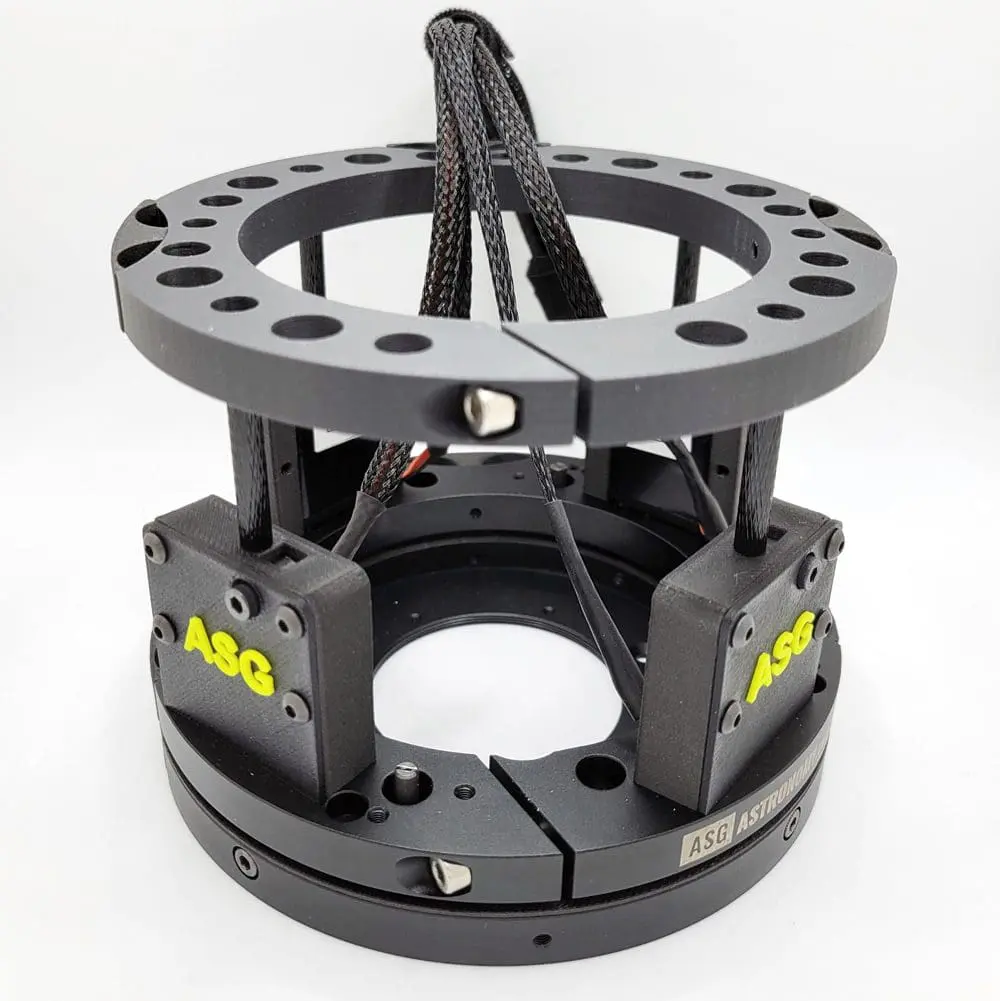
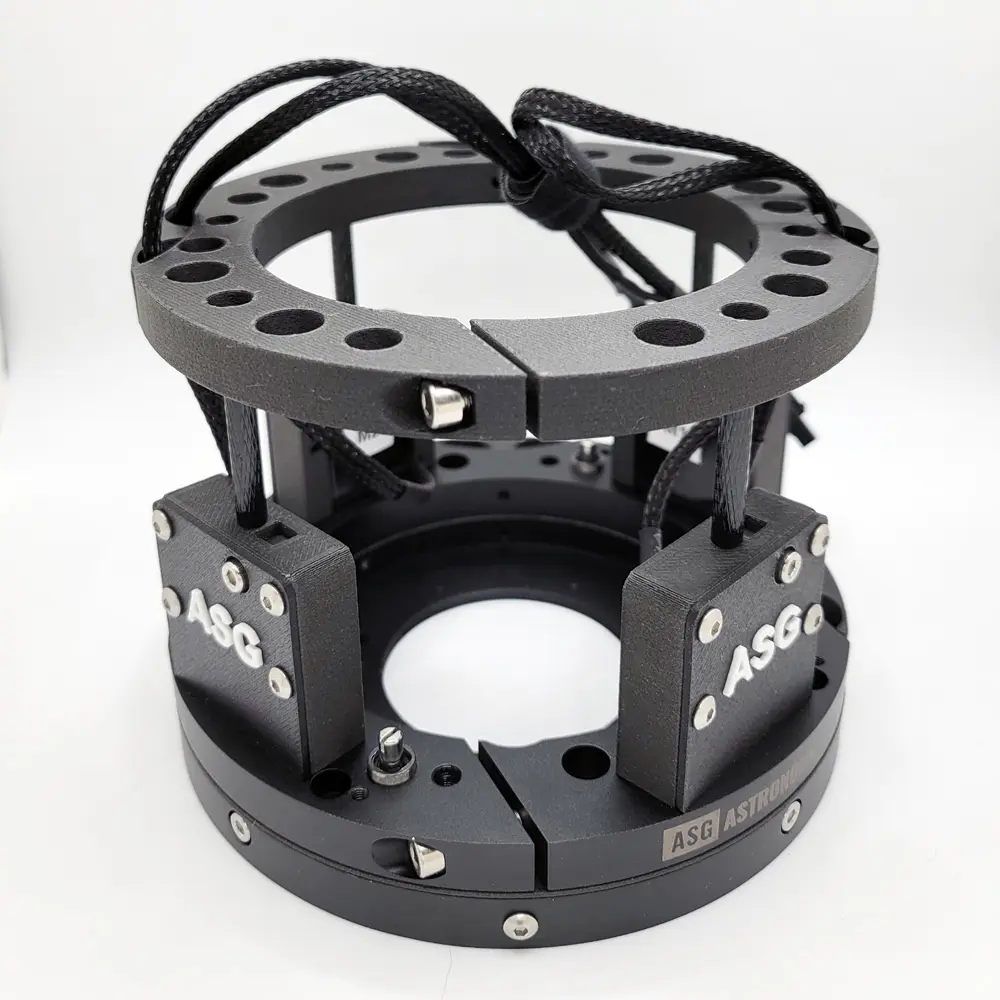
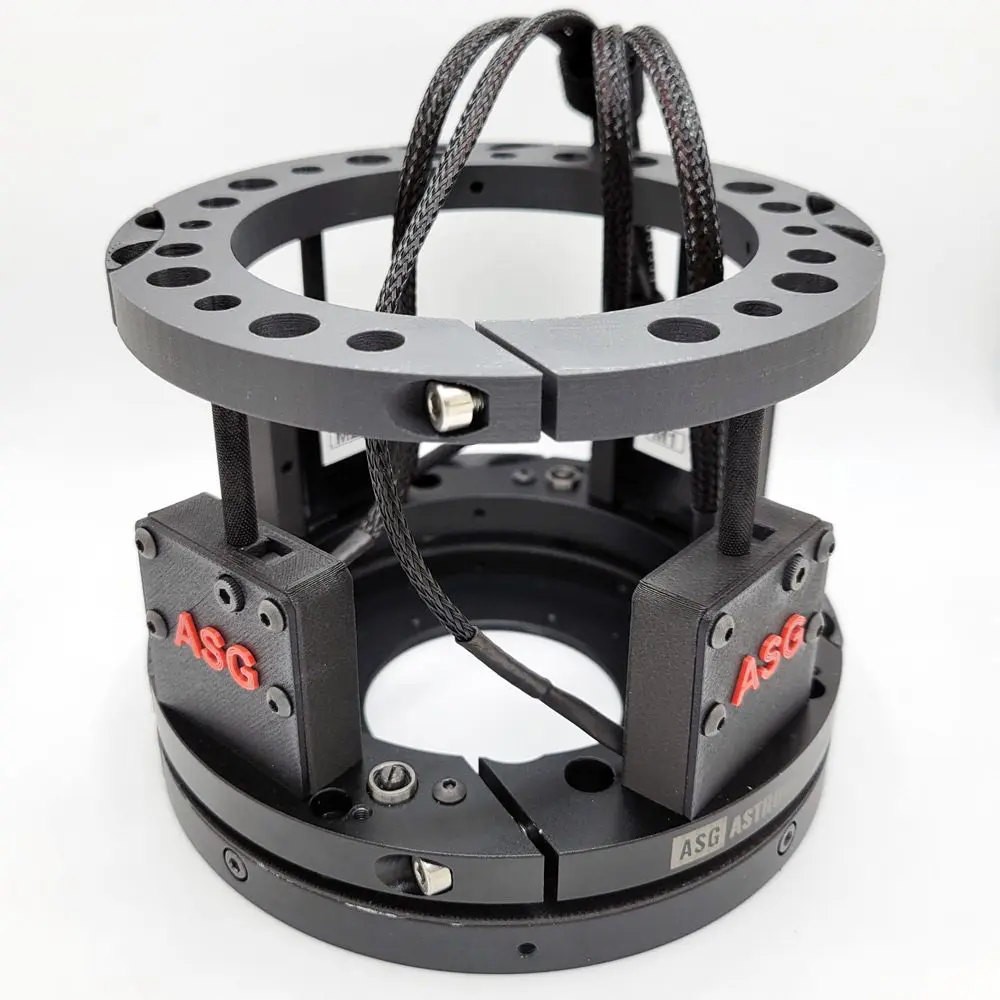
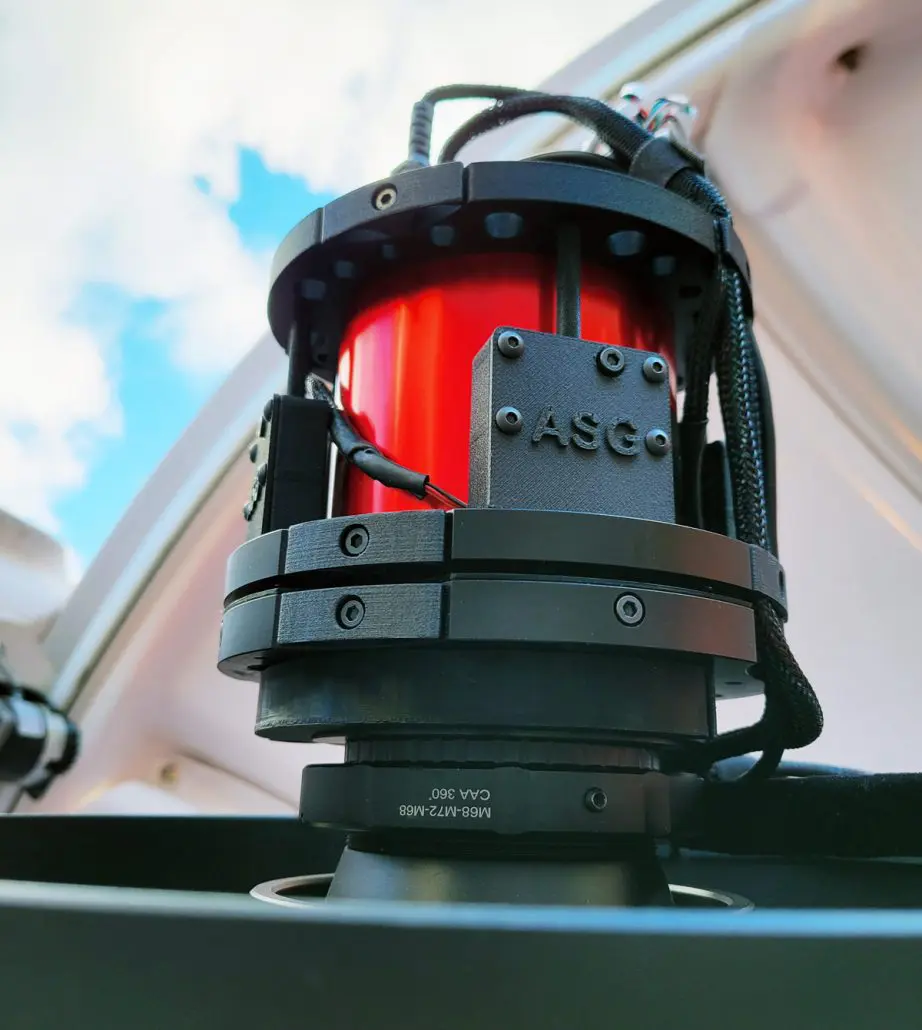
The ASG EAT is unique in that it offers a super light-weight head unit designed specifically to keep weight low and structural integrity very high. Using a combination of CNC machined plates as well as carbon fiber infused lightweight parts, the head unit weighs in at only 23oz. with 4 motors installed. Run your control box separately on your scope elsewhere to save on space and obstruction.
This design not only allows us to bolt to most electronic filter wheels and accessories, but also hang from delicate correctors like RASA or hyperstar setups. Only 3mm thick, and often replaces the existing 5mm thick plates on most cameras, you end up with the exact same backfocus or better than when you started.
Head Unit Design
To keep the volume and head unit weight down, we utilize a mixture of CNC machined plates where we need and 3D printed plates where weight can be saved. At 23 ounces, the unit is easily capable of hanging off the front of a RASA, Hyperstar application, or a lightweight Newtonian eyepiece.
Camera Compatibility
Not only does the unit work with most ASI or QHY cameras that are 90mm in diameter, we can easily adapter player one and moravian cameras into the unit with special adapters we provide. Central obstruction is also kept to a minimal with a slender design and footprint.
Control Surfaces
On the computer side of things, we developed a simple interface to connect to and send commands to the computer through serial inputs. It’s able to tilt across 4 major planes. (left, right, top, bottom, tl-br, tr-bl) Adjustments are very close to micron level, so works very well with calculations off Hocus Focus Here we get tilt down to about 1-2 microns pretty consistently.
Compatibility with ASG Products
The entire product line is compatible with our EAT and Photon Cages. Filter sliders and RASA Pro/Standard systems all incorporate our standard mounting systems, allowing the Electronic Photon Cage to bolt directly to any existing products of ours.
First-Class Software
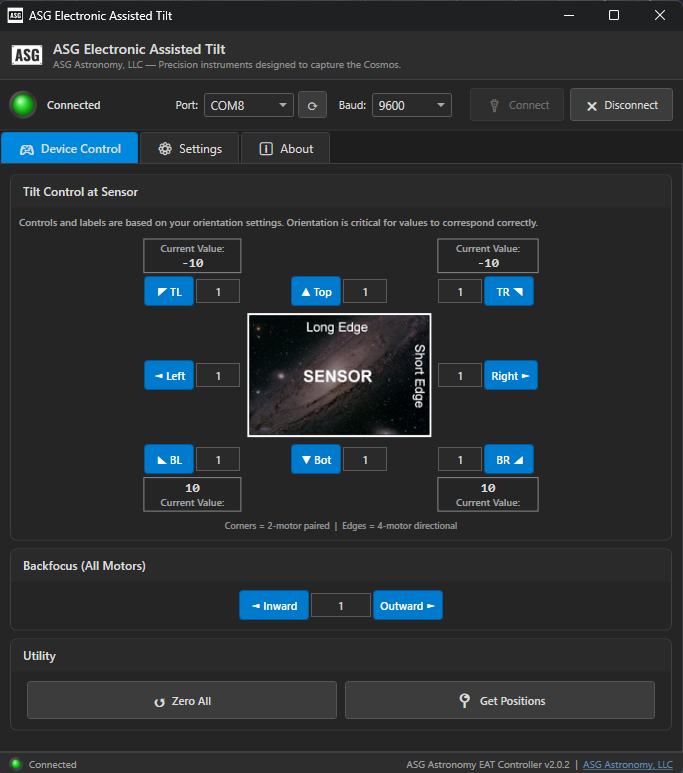
Full control using 4 corner tilting… just like Hocus Focus calculates!
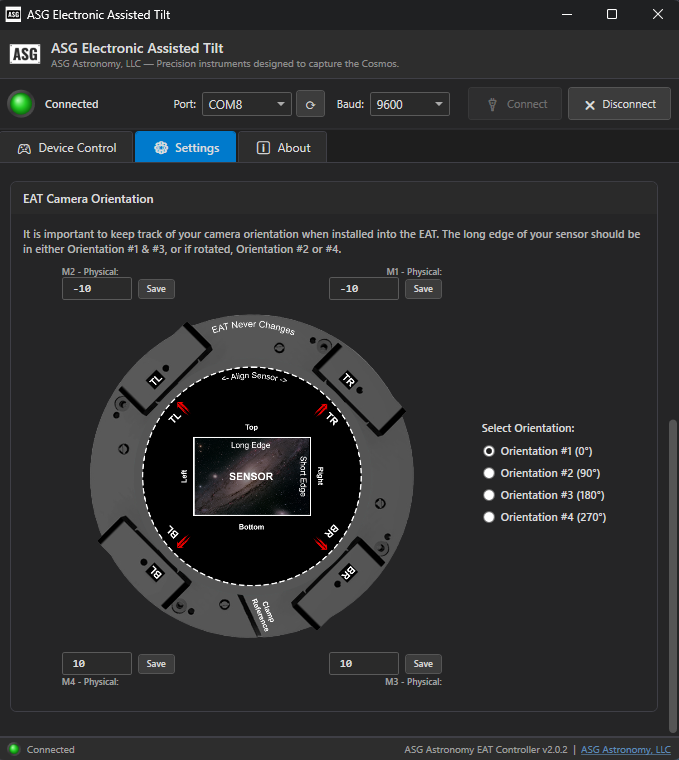
Choose orientations based on how you mount your camera!
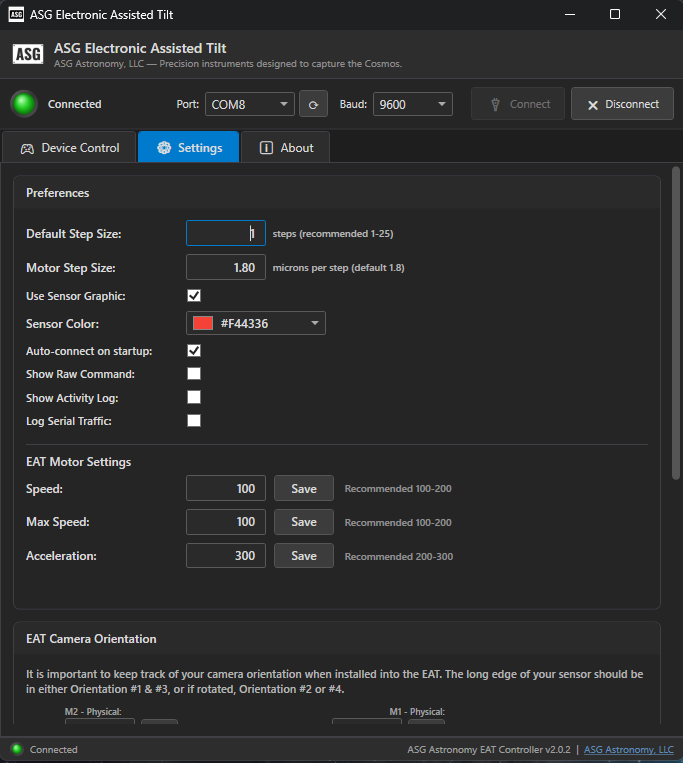
Settings to help you manage your ASG EAT and workflow.
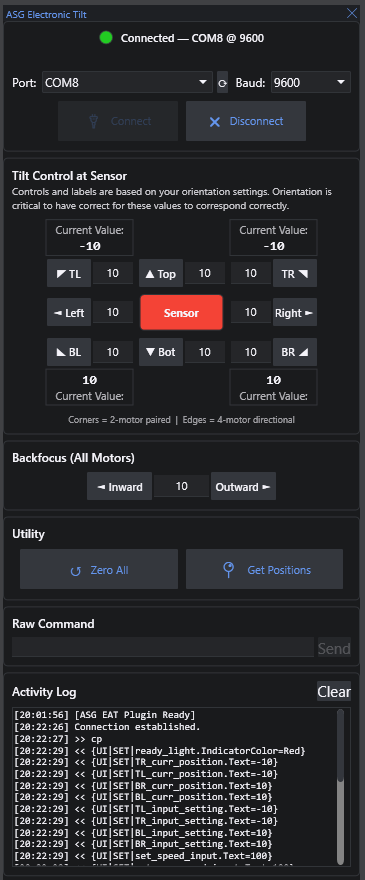
NINA plugin with dockable window controls!
Desktop standalone or NINA plugin
The ASG EAT software system can run as a standalone desktop PC application which connects via a COM port, as well as a NINA plugin to allow direct control from a docked window within the NINA imaging system. Both allow control of your ASG EAT with first in class upgradable software as well as firmware update capabilities should we need to release updates.
Desktop PC App Features
- Adjust tilt down to the Micron Level with Top, Bottom, Left, Right tilt moves or by doing diagonal tilts as well.
- Adjust orientation so that all movements align with your setup.
- Zero out motor positions in the software if needed.
- All changes are saved and flashed so a power lose will not harm the system or lose track of it’s locations.
- Configure motor speed settings or set hard coded positions if needed.
- Firmware updates pushed easily through the PC app
NINA Plugin Features
- Install our ASG Electronically Assisted Tilt NINA plugin
- Dockable window for inside NINA controls panel and easier workflow
- Orientation controls so that movements match your hardware
- Zero out motor positions in the software if needed.
- Configure motor speed settings or set hard coded positions if needed.
- Automation routes are to come with future releases.
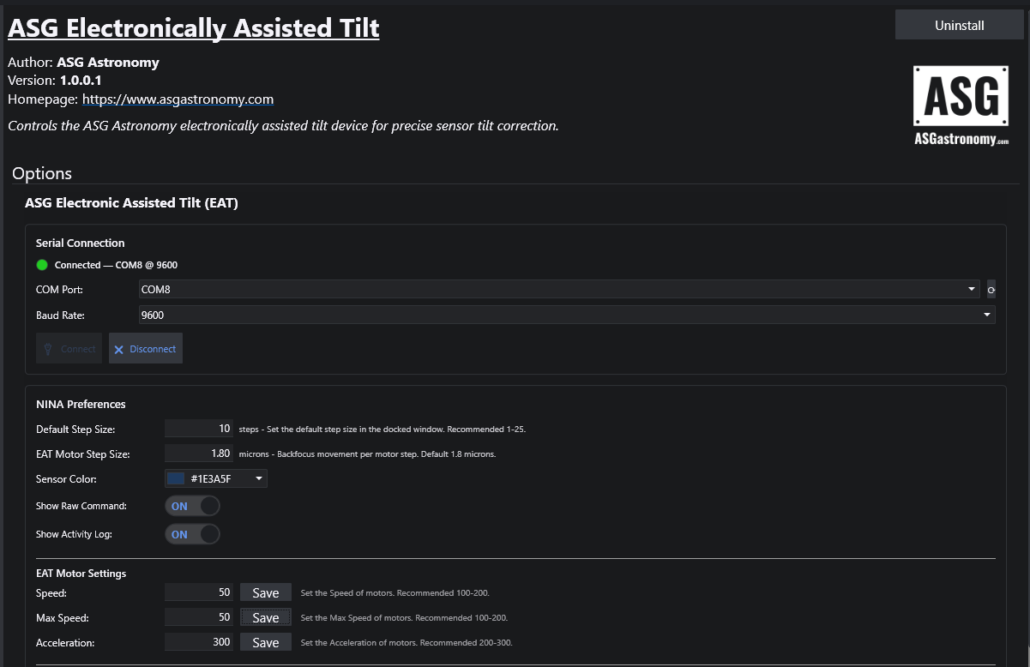
NINA plugin with all the same great features & settings as our Desktop PC App!
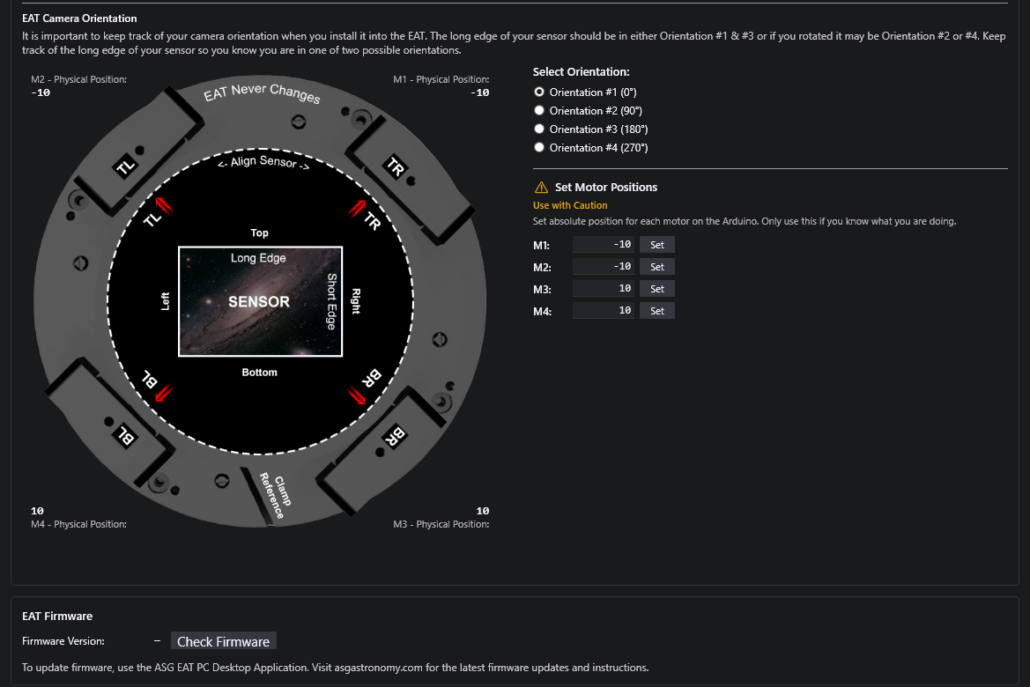
Sensor position and orientation controls in NINA help make changes a breeze.
Ready to build your unit?
View Pricing and Availability, or email us for more info!
Vision
Astrophotography has always been a ( Hardware² * Software² ) = Best Astrophotography equation to myself and many. The vision is to have software systems taking initial photo runs of focus curves, measuring tilt, running a baseline tilt, and then adjusting this sort of stuff automatically just like Electronic Focusing has been done for the hobby… we might be a few years away, but that’s the goal. At present, you can use your favorite tilt software such as ASTAP, CCD Inspector, or better the Hocus Focus tooling to find how much tilt you need to correct and input changes into our platform for quick adjustments.
Resolution
Backfocus can be adjusted independently from tilt allowing for increase/decreasing values. Total backfocus adjustment is around 2mm in and out, while tilting can max at around 1mm difference…. though if you setup right, you should never have to tilt that much or else something is drastically wrong… Currently, the EAT is really good for dialing in final values of backfocus/tilt, not for acting as spacers or overcoming large hardware issues.
Weight
The EAT is light enough we feel comfortable hanging off the front of an astrograph’s corrector… Only slightly over the recommended obstruction of a 11″ RASA, precise enough for full frame at F/2, getting to the above is fairly easy to do all while remotely operated.
Using the ASG EAT system
For anyone who has used a regular tilt device, whether our ASG Photon Cage on down to the regular stock camera tilt plates… one thing is for sure a given; “Patience”. It takes patience to get the sensitive nature of an optical system tilted correctly to where the aberrations will make you stop pixel peeping, if ever!
The EAT system has provided reasonable resolutions down to a near micron or sub-micron levels with good repeatability. It does change how you can actually operate and fix things when you don’t have to necessarily ‘touch’ your telescope.
Coarse Adjustment – Running Live
What used to take 20 minutes you can now do remotely in about 2 minutes. For initial setup, we put the capturing system into 2 second loops and were able to capture quick exposures while live tilting your camera. The incredible part here is you can see the focus portion of your images move across the screen like watching airplane trails or satellite trails. Even run an aberration layout with 3×3 squares and looping exposures gives a real time movement and analysis allowing you to quickly get into focus and most of your tilt removed in minutes.
Fine Adjustment
Once coarse adjustment is completed, you move toward a more fine grained analysis approach using software such as Hocus Focus, ASTAP, CCD Inspector. This process can still take 20-30 minutes (mostly from running autofocus curves) but all from a remote location… either home or thousands of miles away! no more shimming backfocus into submission, or sitting in the cold twisting screws. Just make a few adjustments in or out and test your results with live images.
Future Goals
We currently have a couple dozen units working throughout the globe and in remote environments thousands of miles away. They have been working very well and we also have home units that have been in operation for over a year now with no issues. Our future goals include possibly connecting to automation systems such as Hocus Focus to see if it’s possible to have it run and automate. While not entirely necessary, a future step in the right direction to make improvements to astro imaging techniques.
Customer Rigs
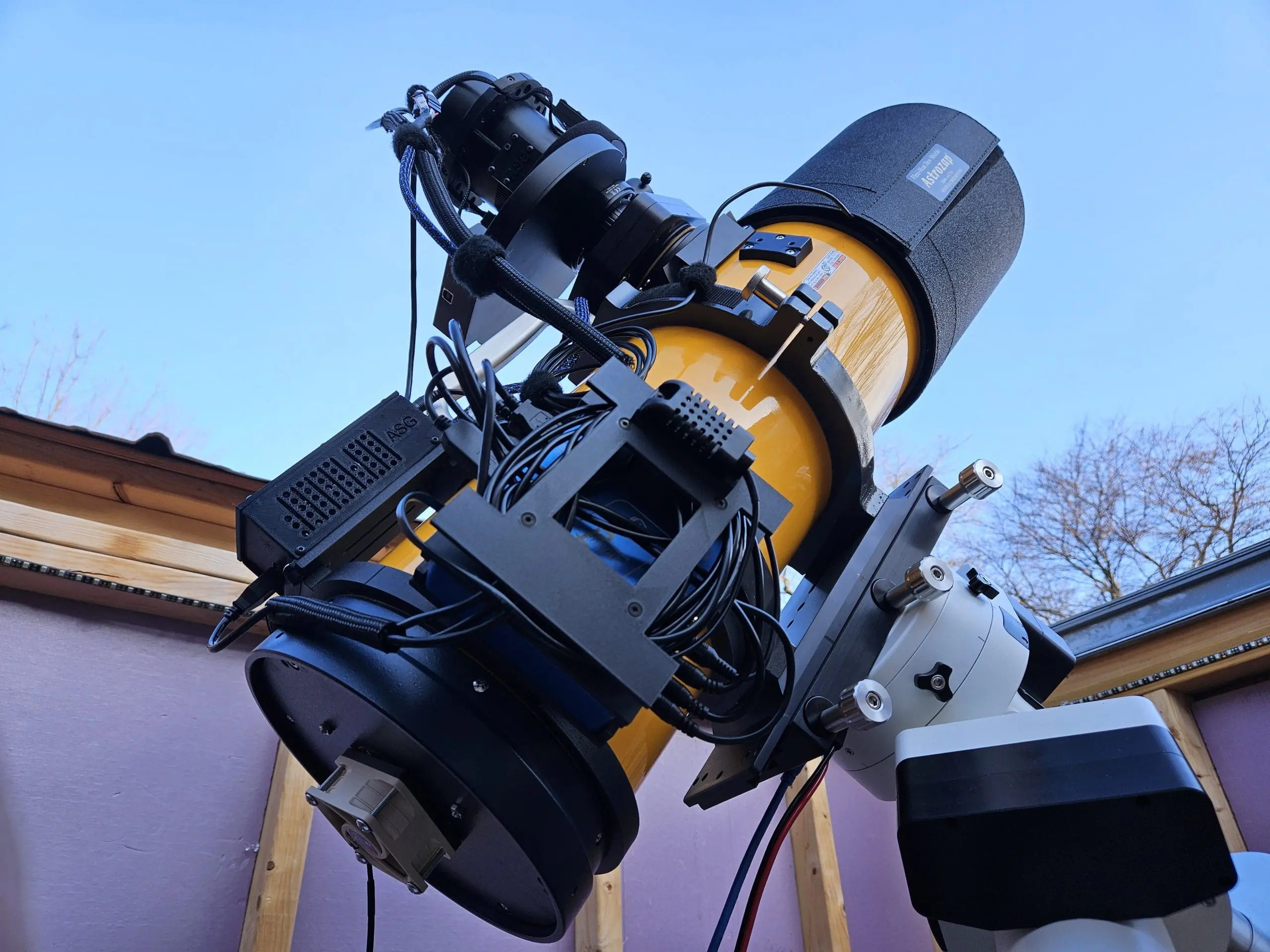
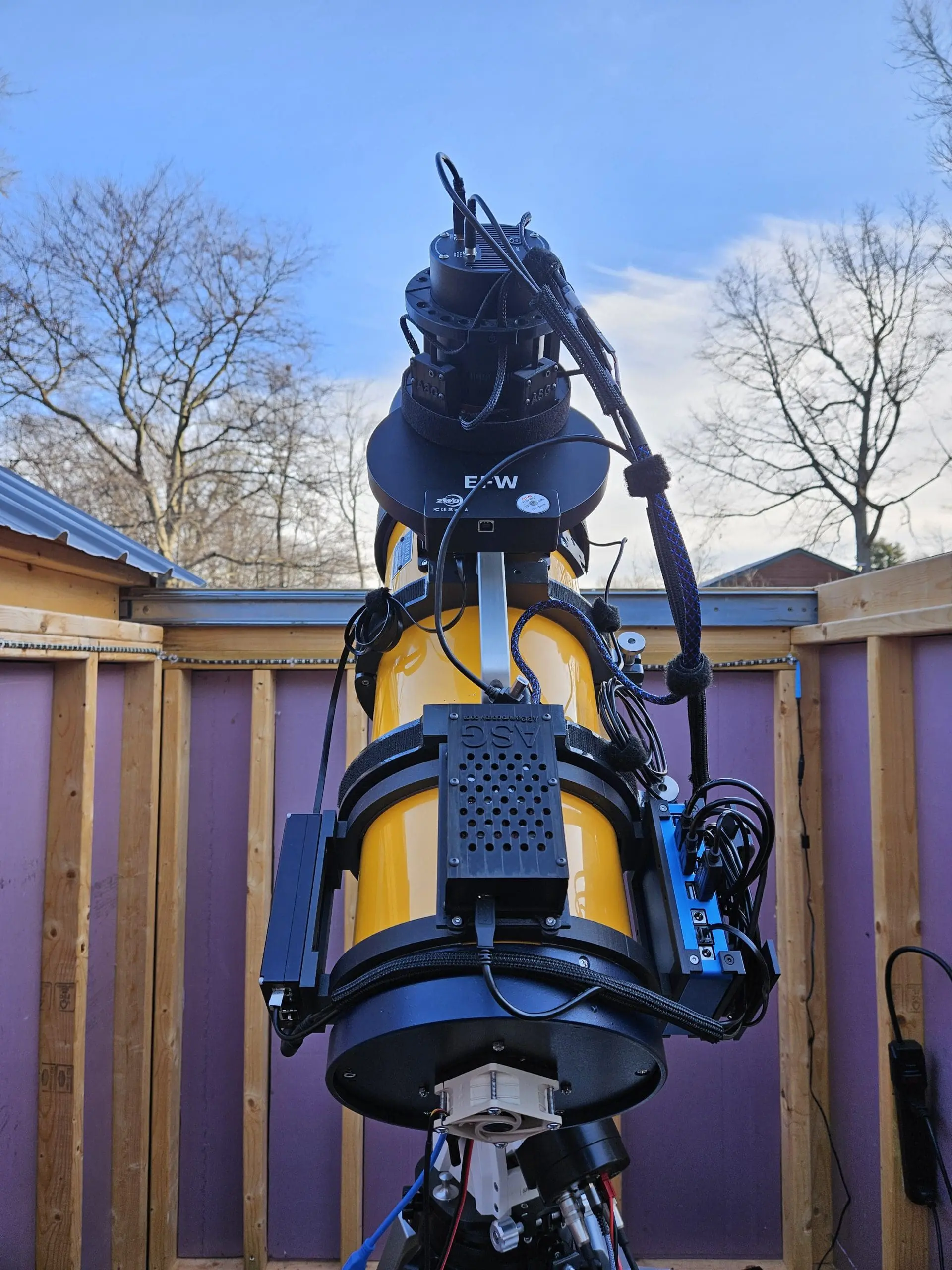
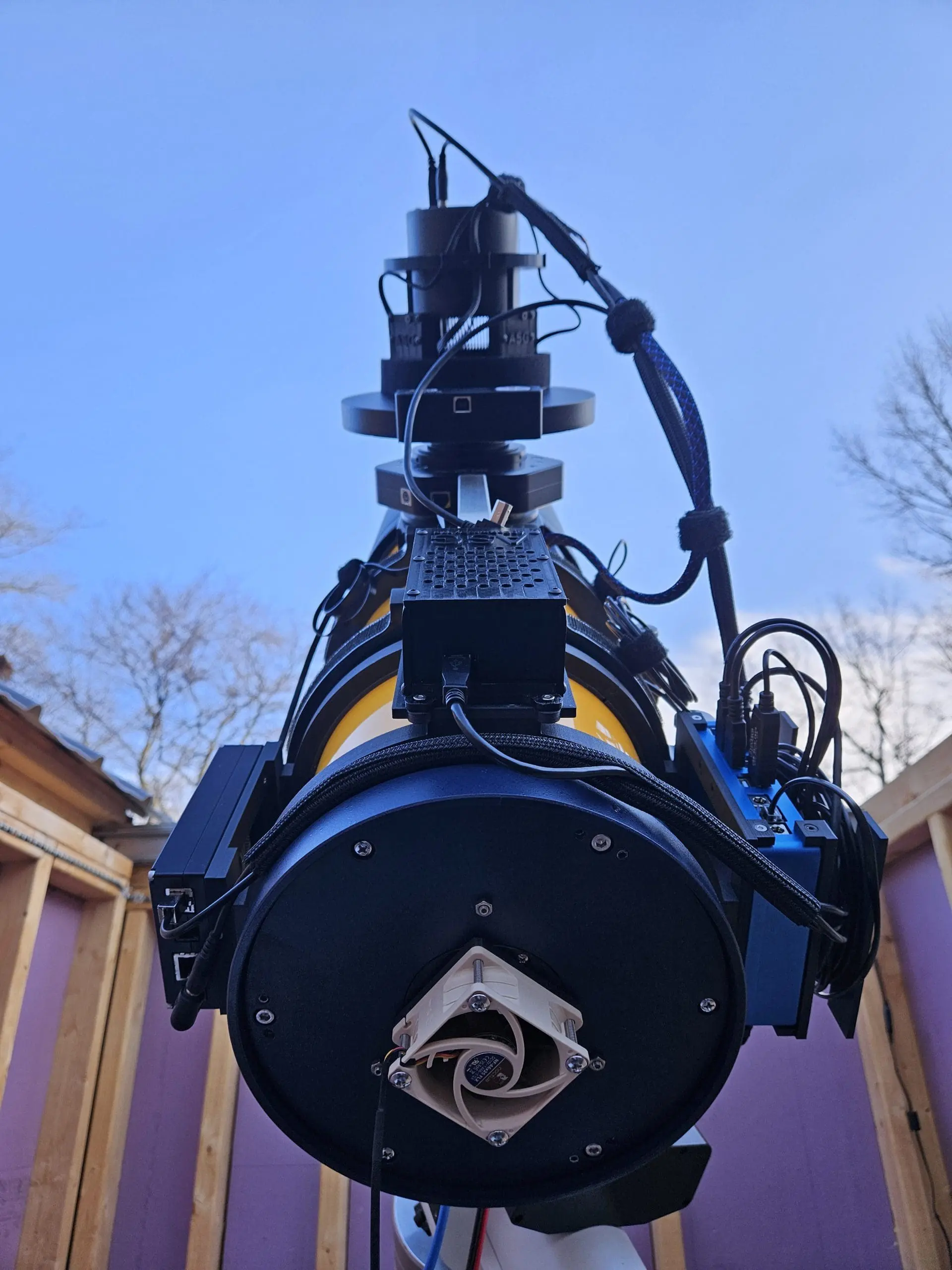
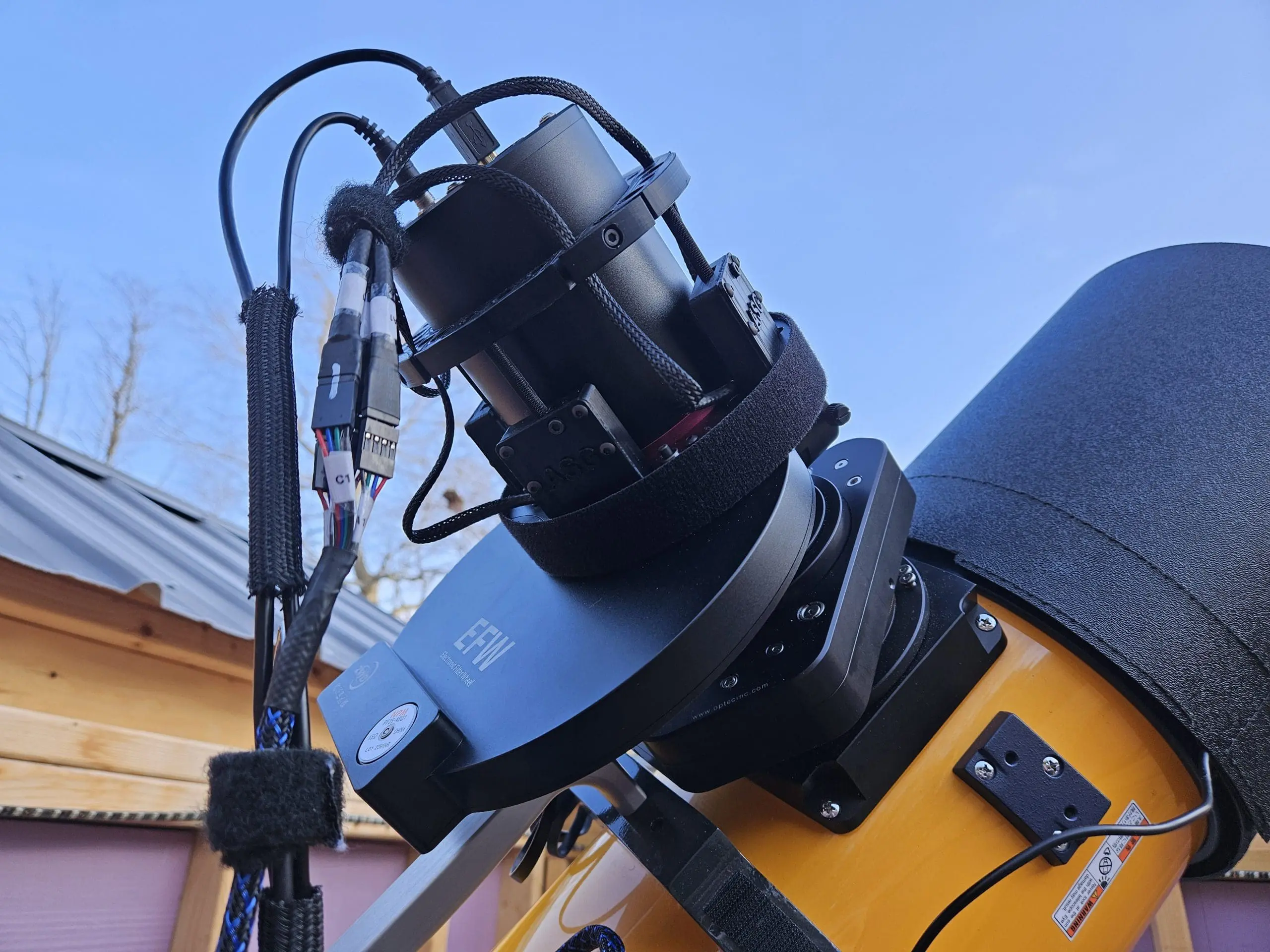
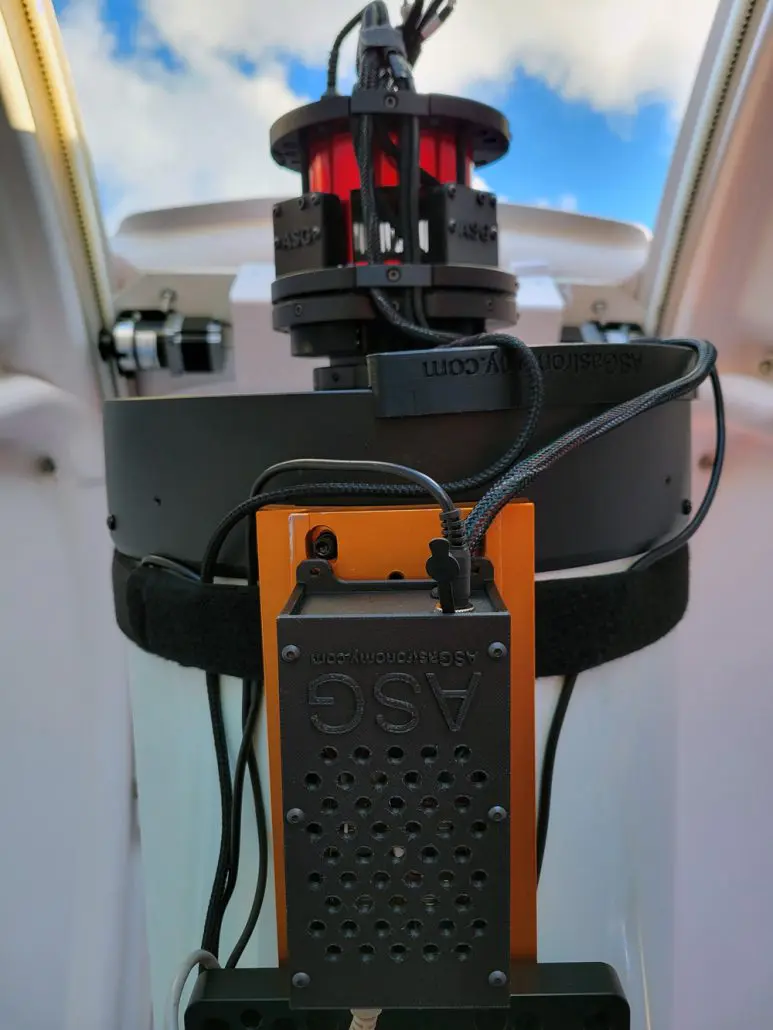
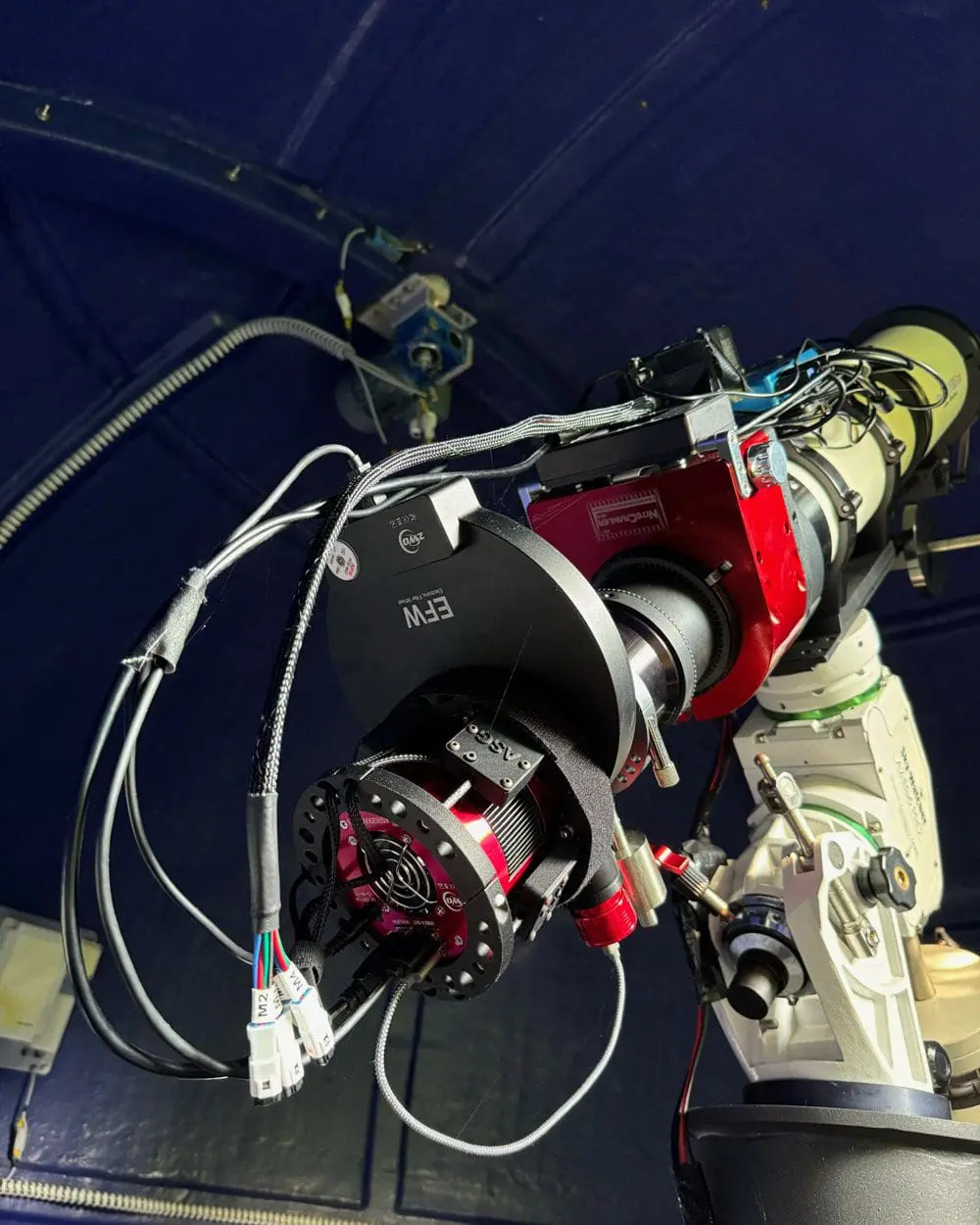
ASG EAT with an Epsilon 160ED
Courtesy of Overcast Observatory, Chris has a prototype mounted on several scopes. In these images, you can see the light weight and size of the EAT mounted on an Epsilon 160ED. The head unit weights only 23 ounces and produces a minimal footprint to work on even small scopes.
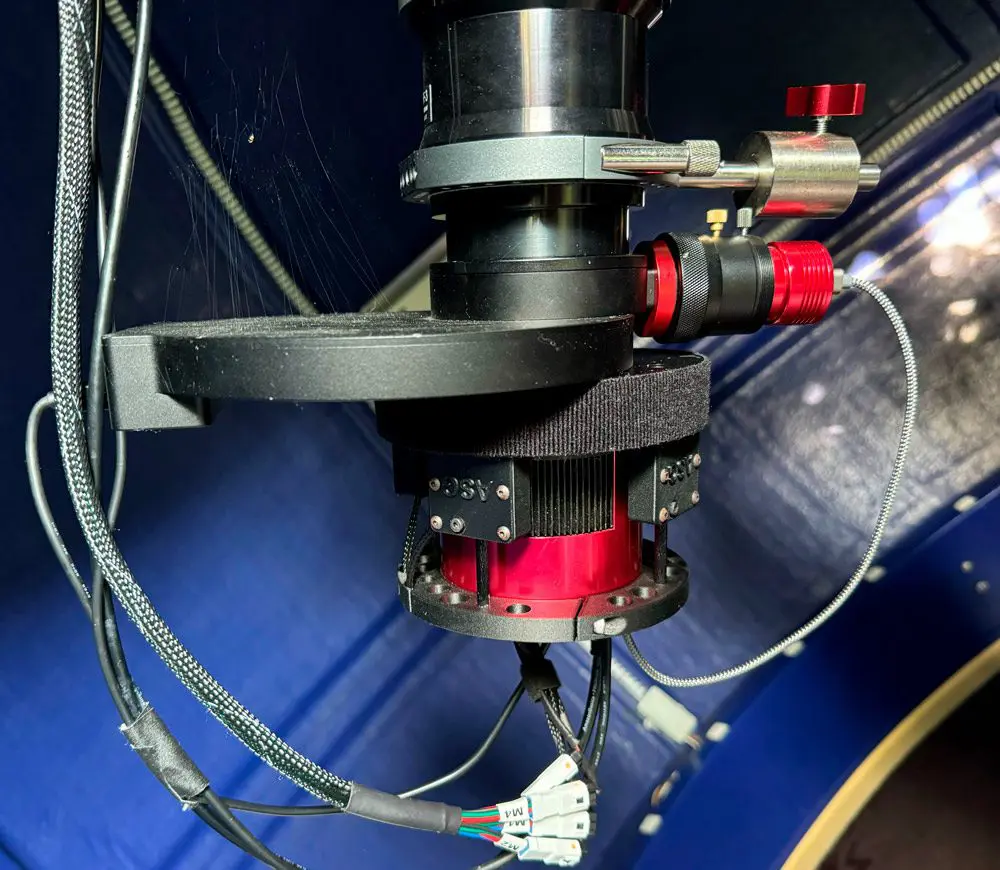
ASG EAT with an Astro Physics 130 GTX Gran Turismo
Courtesy of Nils Harnischmacher of Germany for sending us his photos of his amazing setup running an electronic photon cage. Initial results were successful and Nils noted “It is very easy to install and handle. It made backfocus and tilt adjustments simple.”
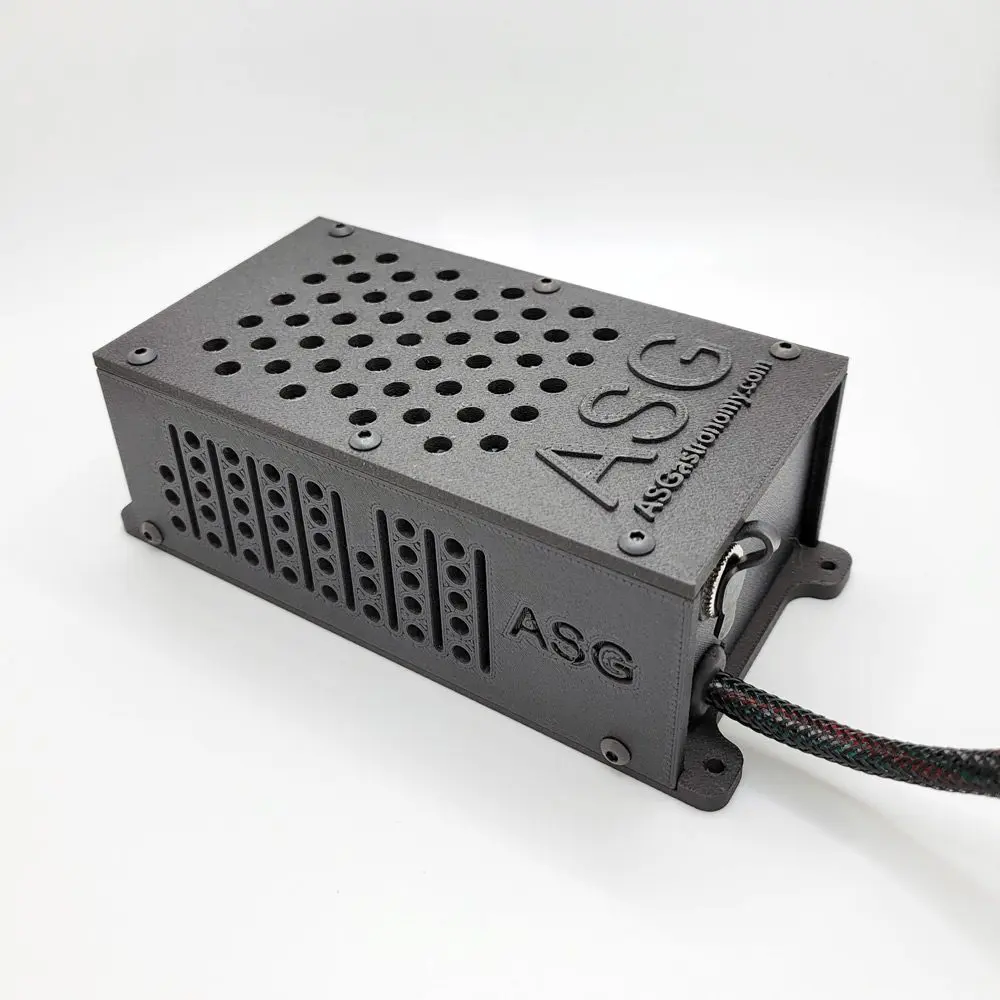
Control Box
The control box runs separate to keep bulk of the head unit down. The unit runs on a simple barrel jack input for 12v power and most power boxes or mounts will work to keep the unit powered. We recommend a switchable power source so you can turn on/off remotely. A standard USB cable is provided to connect to your computer or power box usb hub as well.
Variety of mounting options included:
- Can work with any scope!
- M54 female central threads 3mm deep
- 6 bolt 62mm EFW pattern common on most filter wheels
- 99mm EFW pattern for 50×50 ZWO filter wheel
- Works with all the ASG filter sliders and accessories
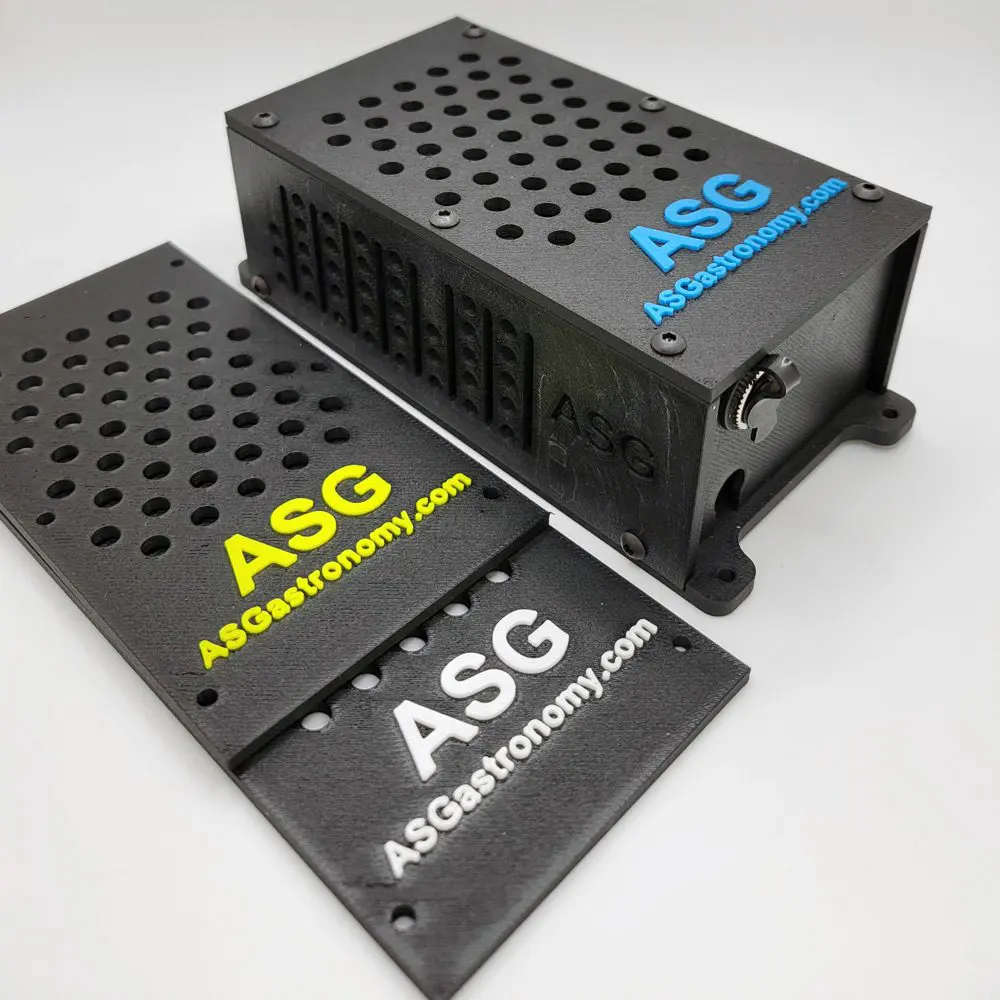
Assorted Colors
We can customize and provide various accent colors to match your equipment if you like.
Windows Software
A single windows software is used to control your Electronic Photon Cage. You can precisely control each corner as well as backfocus through the software, making micron level adjustments remotely all from inside.
Ready to build your unit?
View Pricing and Availability, or email us for more info!