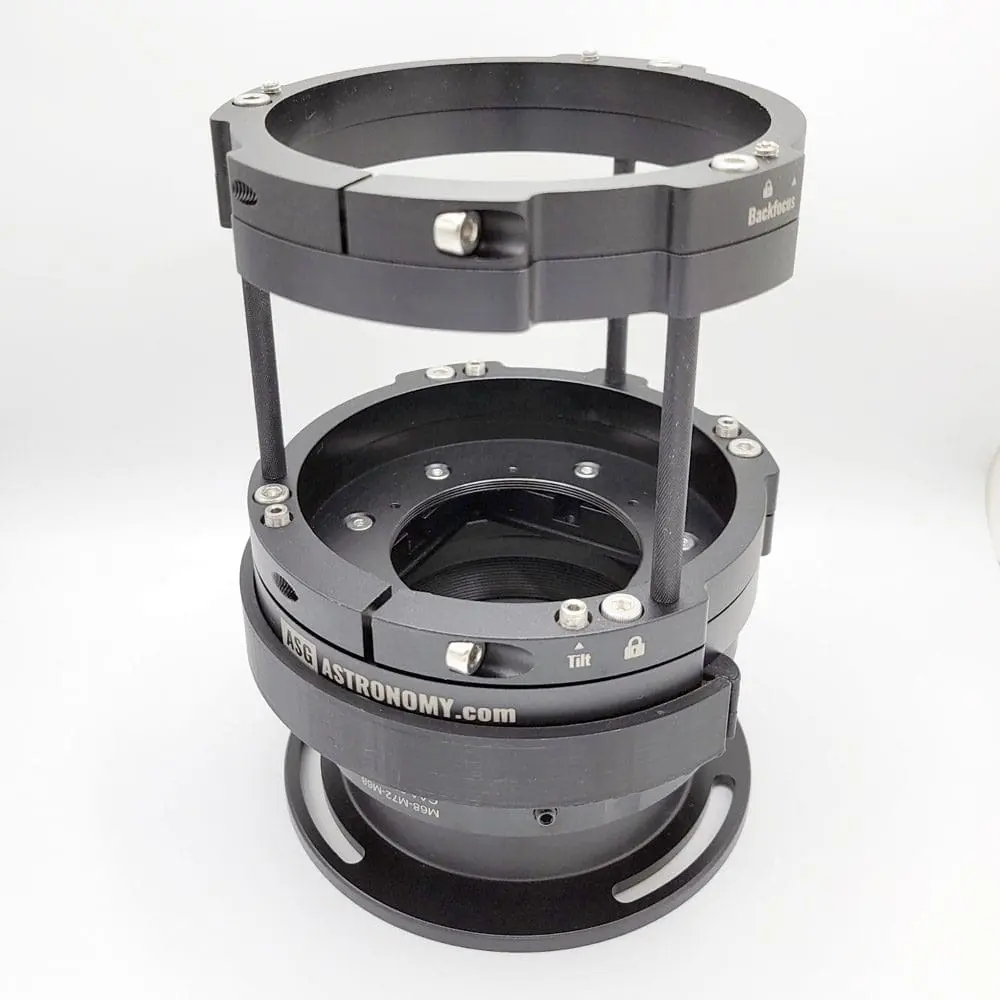
The RASA 11 and RASA 8 need special care in the optical train. Whether you run M42, M48, M54 or M68 can make or break these fast scopes.
01 · The light cone
Why f/2 changes everything
Plenty of telescopes claim a fully illuminated full-frame field. A full-frame sensor has a diagonal of about 43 mm, so a 48 mm optical train should cover it, right? Not always.
At f/2 the light cone from the RASA to your sensor is far steeper than from an f/7 refractor. That steeper cone is where the speed comes from, but your optical train has to make room for it. A 48 mm train can still clip a full-frame sensor.
So how big an optical path does a RASA 11 with a full-frame sensor need?
02 · Modeled to scale
Full frame, perpendicular
We built 3D models of the RASA 11 light cone at f/2.2 across a 72.8 mm backfocus, covering a 43.3 mm full-frame sensor, to see exactly how the camera mount, rotator and filter slider affect it.
An M68 camera mount is wide enough at the base to stay clear of the cone. With 50×50 mm square filters on the Photon Cage, the filter mounts and screws sit outside the cone on the perpendicular axis, with spare room at the sensor for the screw cross-section.
03 · Diagonal, 50×50 mm
Zero obstruction at the corners
Next, a cross-section through the sensor’s widest point, the diagonal. Neither the M68 base nor the 50×50 mm filter system touches the light cone anywhere.
The result: full corner-to-corner performance from an f/2.2 RASA 11 with a full-frame sensor.
04 · Diagonal, 2-inch
Where 2-inch filters fall short
The same diagonal cross-section with a 2-inch filter shows significant obstruction from the filter assembly at the height the filter sits.
Filter trays on most full-frame setups sit 16–18 mm from the sensor, since most full-frame ZWO cameras have 12.5 mm of backfocus. A camera with more backfocus, like the QHY600, pushes the filter further out and makes it worse.
05 · Real images
2-inch vs 50×50 mm, same scope
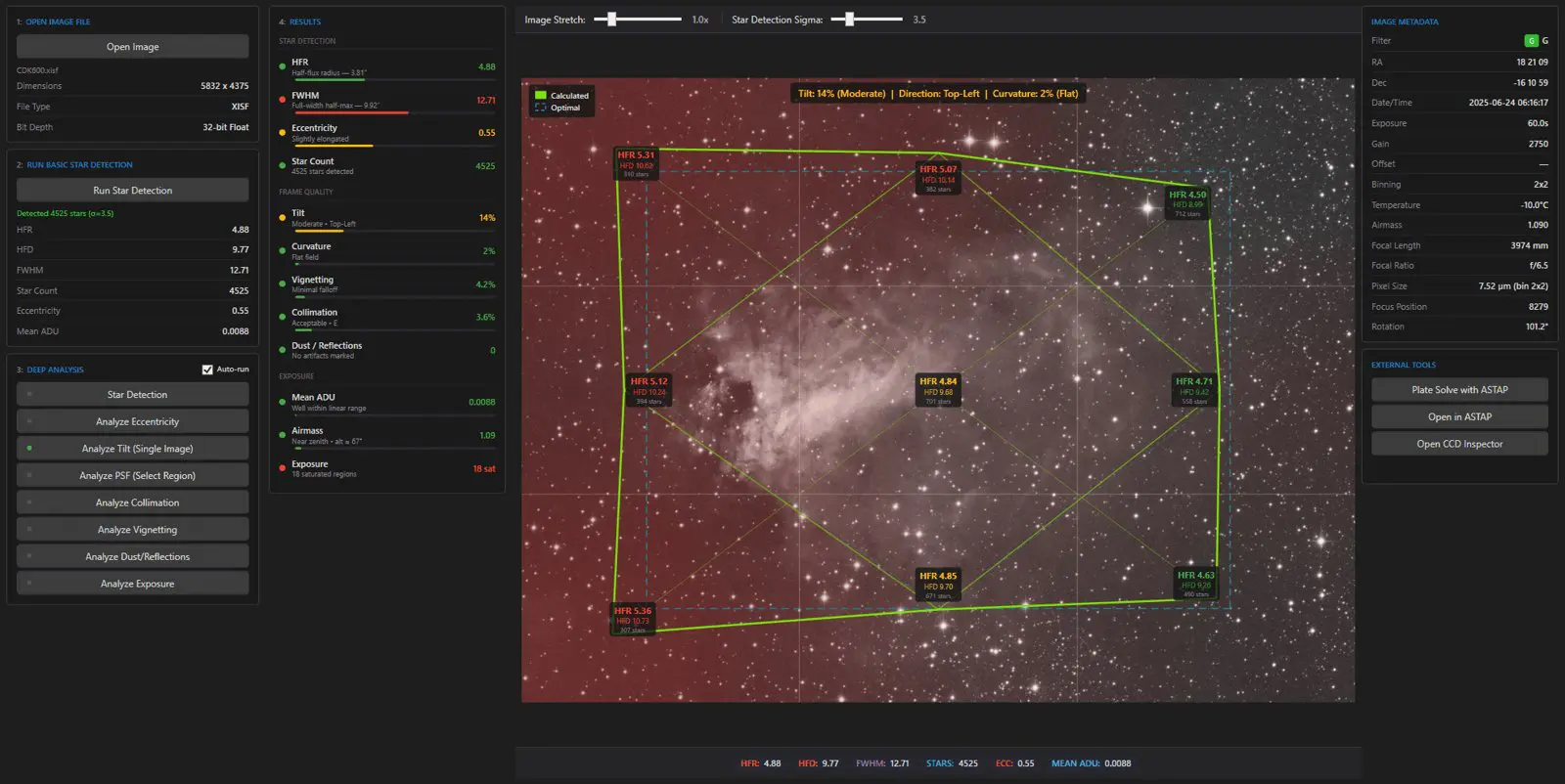
Both are stacked, dithered images from a RASA 11 with a full-frame sensor, so single-sub, guiding and tilt issues are out of the picture.
2-inch · M54 mount
Good, with soft corner tips
Taken with 2-inch round mounted filters and an M54 camera mount. Quality holds up until the very tips of the stack, where corner stars show artifacts from the obstruction.
Some corner vignetting is expected on any RASA; Celestron notes some light loss in the corners regardless. Flats handle it well, and a light crop removes the edge stars.
50×50 mm · M68 mount
Round stars in every corner
Same scope and sensor with our M68 camera mount and a 50×50 mm Astronomik MaxFR Ha filter. The corner stars are round and symmetrical, in a system with almost no tilt or backfocus error.
Performance is consistent on all four edges, and the frame is usable with no cropping beyond the dither zone.
06 · Our recommendations
M42, M48, M54 or M68?
Our opinion, from running a lot of RASA configurations. Your results may vary.
RASA 11
Full frame (ASI 6200, QHY600)
PRO Edition · M68. If you can, go M68 mount, M68 rotator and the M68 PRO filter slider with 50×50 mm filters. You’ll be at the limit of the scope, with its own vignetting but no obstruction from accessories. M54 works too, with slight vignetting and corner coma; pair it with 2-inch filters and good flats.
APS-C (ASI 2600, QHY268)
Standard M54 or PRO M68. An excellent match. M54 with 2-inch filters and good flats gives quality images to the edges. M68 with 50×50 mm filters helps all the way through, but isn’t as necessary as on full frame.
Smaller sensors (ASI 1600)
Standard Edition · M54. The stock M48 with 2-inch filters works fairly well, but M54 with the Photon Cage gives almost no vignetting and very flat images. The stock felt-backed M48 mount is prone to tilt.
RASA 8
Full frame
Not recommended. The RASA 8 is designed for up to APS-C. Use the stock M42 adapter, or our 2-inch slider and Photon Cage built for its very short backfocus.
APS-C (ASI 2600, QHY268)
RASA 8 Edition with slider. Very good with 2-inch filters on our modular base, made for the 2600 on the RASA 8 with removable filter sliders. A huge f/2 field with the flexibility to run mono.
Smaller sensors (ASI 1600)
Standard Photon Cage + slider. The stock M42 camera mount with our standard slider and 2-inch filters gives very flat, vignette-free images. An excellent combination.